“Play is the work of childhood.” Jean Piaget
Children naturally gravitate towards play. My favorite memories of childhood and of my children’s early childhood are all the times spent in play. When my children were young so much of their time was spent in imaginative play. My son spent years riding couch cushions that were ‘bull cows’ before turning into a kung fu warrior, thanks to Kung Fu Panda. When his little sister came along she brought her babies and stuffed animals along on their kung fu missions. They would turn our cut bamboo into dragons, build forts both inside and out, and turn any box into a toy.
Play is fundamental to how children learn. It impacts the cognitive, social, and emotional development of children. With every stage of childhood, you can see a unique stage of play taking place. At each unique stage of play, both growth and development are happening. This is why allowing time for play in these early years is so crucial to the foundation for a life of learning.
The preschool years are defined as ages 3 to 5 years old. During these early years, it can be so tempting when we begin preschool at home, to turn our home environment into a classroom like you would find at a public preschool or private school. Are there elements you can take from those environments and incorporate into your home, of course, but schooling at home gives your children the freedom to learn through play in preschool and into elementary school.
How can we set up our home environment to promote learning through play?
- Design Playful Learning Environments
Any environment that allows children to play while engaging hands-on with their surroundings is going to create a perfect environment for learning through play.
- Set up an art station that allows your children to explore and create new things. You can use items you might have considered throwing away. These items could be old magazines, paper clips, clothes pins, or colorful tissue paper- there are endless possibilities.
- A reading box or nook could be set up and changed out depending on what their interests are at any given time. If they are interested in flowers you could get books from your local library about gardening and plant a small flower garden.
- Integrate Learning Into Everyday Play and Activities
Questions that we naturally ask our children while they are playing or working alongside us are great ways to integrate learning into play. When we do this children are naturally taking in and absorbing the information without realizing they are even learning.
- How many times did you jump over that rock?
- What color is your jacket?
- How many eggs do we need for the pancakes?
- Encourage Nature Play
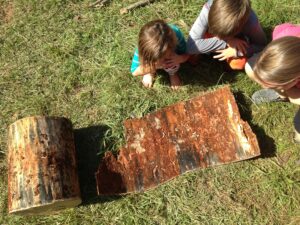
Nature is a beautiful teacher- the sounds, sights, and smells. So much learning can happen when we are outside.
- Set up a mud kitchen with real kitchen tools: measuring cups and spoons, older pots and pans etc.
- Go on scavenger hunts and make a collage with what you find.
- Set up a bird-watching/listening spot with bird books and binoculars.
- Collect flowers, rocks, or sticks.
- Take a pocket microscope outside and look at plants or bugs.
- Engage In Role Play and Imaginative Play
Imaginative play fosters language development, and social skills, as well as helps with problem-solving skills. Most children will pretend to play different roles all on their own- policeman, puppy dog, mommy, daddy, baby sister, or brother. We can encourage this type of play with just a few things.
- Set up a box of pretend play clothes.
- Go to a children’s hands-on museum.
- Go tour of a fire station.
- Pretend to be a different animal game.
- Get books from the library about different jobs.
Homeschooling during the preschool years should be full of playtime. While it may be easy to get caught up in using certain curriculums, at this age play should be what you focus on the most. After all, it is the work of childhood.